Showing posts with label church universal. Show all posts

Sunday, August 24, 2014

Imperative

Imperative from Joseph Taber on Vimeo.
Matthew 16:13-20

13Now when Jesus came into the district of Caesarea Philippi, he asked his disciples, “Who do people say that the Son of Man is?” 14and they said, “Some say John the Baptist, but others Elijah, and still others Jeremiah or one of the prophets.” 15He said to them, “But who do you say that I am? 16Simon Peter answered, “You are the Messiah, the Son of the living God.” 17And Jesus answered him, “Blessed are you, Simon son of Jonah! for flesh and blood has not revealed this to you, but my Father in heaven. 18And I tell you, you are Peter, and on this rock I will build my church, and the gates of Hades will not prevail against it. 19I will give you the keys of the kingdom of heaven, and whatever you bind on earth will be bound in heavens and whatever you loose on earth will be loosed in heaven.” 20Then he sternly ordered the disciples not to tell anyone that he was the Messiah.

This is the Word of the LORD
Thanks be to God

Isaiah 51:1-6

1Listen to Me, you who pursue justice,
You who seek the LORD:
Look to the rock you were hewn from,
To the quarry you were dug from.
2Look back to Abraham your father
And to Sarah who brought you forth.
For he was only one when I called him,
But I blessed him and made him many.

3Truly the LORD has comforted Zion,
Comforted all her ruins;
He has made her wilderness like Eden,
Her desert like the Garden of the LORD.
Gladness and joy shall abide there,
Thanksgiving and the sound of music.

4Hearken to Me, My people,
And give ear to Me, O My nation,
For teaching shall go forth from Me,
My way for the light of peoples.
In a moment I will bring it;
5the triumph I grant is near,
The success I give has gone forth.
My arms shall provide for the peoples;
The coastlands shall trust in Me,
They shall look to My arm.

6Raise your eyes to the heavens,
And look upon the earth beneath:
Though the heavens should melt away like smoke,
and the earth wear out like a garment,
and its inhabitants die out as well,
My victory shall stand forever,
My triumph shall remain unbroken.

This is the Word of the LORD
Thanks be to God.

Listen! Look! Look! Hearken! Give ear! Raise your eyes! Look!

Seven times in six verses, God gives us a word that commands us to act. The Lord of heaven and earth issues an Imperial Decree, and we are expected comply.

Listen, look, look, hearken, give ear, raise your eyes, look!

We 21st century American Christians tend to shy away from talking too much about God's commands. We're much more comfortable hearing about how God invites us to join with what God is doing, we'd rather not hear as much about what God expects us. Instead, tell us again about how God loves us no matter what we do or think.

God is speaking to a people who are empty, who have spent so long trying to just get by in a world full of exile and terror. People who inherited vineyards which they did not plant, only to see the beauty of the earth melt away as they were taken from their places of comfort.

This passage is not addressed to the righteous, the delivered, the victorious. It's addressed to those who are chasing it down. “Listen to Me, you who pursue justice. “This word is for those who are desperate for hope, but haven't found it yet.

God's people are in exile, far away from the land that symbolizes the covenant, far away from the trappings of their temple worship, far away from their connection to the ancestral inheritance. They are in Babylon. Yet even in exile in Babylon, God calls them to pay attention to their roots, which are not just in Israel and Judah, or in Sinai, or even Egypt. For once, long ago, God told a man named Abram to get up and leave the city and house of his father and to go to a place where God would show him. So Abram, who would become known as Abraham, left the city of Ur, an ancient  city in the Babylonian empire. Even in exile, God reminds the people of their roots, of the covenant God has bade with them. Look at the quarry from which you were hewn. Look at the rocks from which you were formed. Listen, look, look, hearken, give ear, raise your eyes, look!

These divine commands, these orders from on high, God's Word made imperative, are not instructions to go on a spiritual journey or to enact some sort of ritual. The people to whom God is speaking cannot carry their end of the relationship, at least not yet. These seven verbs grab our attention and orient us to a God who is acting. Listen, look, look, hearken, give ear, raise your eyes, look!

We've been waiting for a long time to see God's action. We've trained ourselves to see God in the small actions, but we long to see God really roll up his sleeves and do something amazing. We remember a time when the pews were so full we had to think creatively about how to fit everyone inside the church, and many congregations built larger grander sanctuaries as well. Now we see not only available seats, but pews which lie empty, like unplanted fields gone to weeds. We remember a time when church life was the center of whole communities. Now we see communities, even communities of faith, divided by political differences and family squabbles.

Is that the rock we were hewn from? Is that the quarry from which we were dug? Are we to remain in this desert of institutional decline? No wonder God is issuing commands! It’s time for us to turn things around, to be ready to act, if we just work a little harder at what we’re doing, everything will go back to the way it was, a whole company of believers making sure that the church is the focus of society!

God's word spoken through the prophet Isaiah does not call some spiritual army to attention, it calls us to pay attention. This text does not point us to our own action, or even our own comfort. The focus of this passage, and ideally of the life of the church, is on what God is doing. Because God is about to make the wilderness like Eden, the desert like the Garden of The Lord.

Listen, look, look, hearken, give ear, raise your eyes, look!

None of these verbs are missional, or empowering, they do not invite participation in the work God is doing, they don't even require purity or the right belief. They are all observational. Listen. Look. Look. Hearken. Give ear. Raise your eyes. Look!

As God speaks these words to them, the people of God are too beaten down to participate in what God is doing. They're just too tired to respond in faith. Too many years of decline, too many years of chasing after justice, and never reaching it. God's people, in this text, need to be reminded that God is acting, that God is mighty, and that God is working for their good.

So God commands them to pay attention, and to remember to whom they belong.

We are dug from the same quarry, hewn from the same rocky ground, as our spiritual ancestors. But God can make that rocky wilderness like Eden. God transforms the desert into the Garden of The Lord. Our spiritual ancestors did not accomplish great things, or even great faith, by themselves, or grow from two old people into a nation, a childless couple into the Matriarch and Patriarch through whom all peoples bless themselves. Only God can do that. So why do we focus so much of our attention on replicating their results through our own feeble efforts, instead of trusting in the God who is leading us to a land which God will show us?

Our exile is spiritually exhausting. We’re so tired of trying to continue forward out of our own strength, which we know is not sufficient. In our anxiety, we make decisions based on what we think will make our denomination not decline as quickly. We try and hold on to our resources because we can only see the day when they run out. We forget that the church is not called to promote itself, but always to Proclaim the Lordship of Christ. We exile ourselves with our own sense of self-importance, until we find ourselves in a land where anxiety and fear abide, hand-wringing and the sound of worry.

But even in our exile, God is still at work, bringing us back to himself, to the land which God will show us. Gladness and joy shall abide there, Thanksgiving and the sound of music. Listen, look, look, hearken, give ear, raise your eyes, look, for God is acting. Christ is Lord of heaven and earth, even though that looks different, in our different world, than it looked for our ancestors. Even in exile we have hope in God,  whose “arms shall provide for the peoples; The coastlands shall trust in [God], They shall look to [God’s] arm.”

We know that God is faithful to the covenant even when we are not. We have seen this theme played out time and again throughout scripture, church history, and our own lives. What has gone before us is not to be discarded, ”Our ancestors and their history and connected to our hope; our hope is the foundation of our future. God's promises to Sarah and Abraham flow to and infuse hope in the exile.” Out of exile comes life, and beauty, and a people who are reformed, and are always being reformed. They are different, sure, and have their own particularity, but they are also connected to all the saints in every time and place. Listen. Look. Look. Hearken. Give ear. Raise your eyes. Look!

We share hope in a new minister, and a new congregation. We see fruits beginning to flourish within ourselves and one another, we're caught up in the excitement of new life, where we had only seen a dormant grind for so long. But that newness will fade into a mature and trusting Pastoral Relationship. The hope of newness is ephemeral and will fade. the hope in God’s promises to our ancestors is sure, even though we do not know the form it will take.

God says For teaching shall go forth from Me, My way for the light of peoples. In a moment I will bring it; the triumph I grant is near,” The teaching which shall go forth from God gives us the words to answer “Who do you say that I am?” with “You are the Messiah, the Son of the living God.” Listen, look, look, hearken, give ear, raise your eyes, look! God’s imperative to us is not to grow in stature, or number, or to fit in with the culture, or be popular. God doesn’t issue a call to attention so that we will be ready to act immediately, God calls us to pay attention so that we will see who God is, and be able in all things to proclaim the Lordship of Christ. Listen. Look. Look. Hearken. Give ear. Raise your eyes. Look!

These commands remind us of God's love, they connect us to the narrative that gives the events of our lives meaning. Listen, look, look, hearken, give ear, raise your eyes, look! "Though the heavens should melt away like smoke, and the earth wear out like a garment, and its inhabitants die out as well, My victory shall stand forever, My triumph shall remain unbroken.”

So the church remains connected to the rock frown which we are hewn, to the quarry from which we were dug. We still pursue justice, but we find ourselves watching for God, exploring creation with the hope that we will find what God is already doing for us, to us, and through us. We respond in faith when we are able, and when we cannot, God commands us to Listen. Look. Look. Hearken. Give ear. Raise your eyes. Look!


God's commands remind us of the covenant, and call us to remember the wonders God has done in our sight in the past. So our obedience to God’s command is not an obligation, but a joy. God’s commands remind us of the covenant, linking our action to the reasons we act. God’s imperative empowers our declaration that Christ is Lord. QGod’s victory shall stand forever, God’s triumph shall remain unbroken,” and we listen, look, look, hearken, give ear, raise our eyes, look, and finally answer, QJesus is the Messiah, the Son of the Living God.”

Sunday, August 3, 2014

Go, Therefore


1 Kings 19:9-18
9At [Horeb, the mount of God, Elijah] came to a cave, and spent the night there. Then the word of the LORD came to him, saying, "What are you doing here, Elijah?" 10He answered, "I have been very zealous for the LORD, the God of hosts; for the Israelites have forsaken your covenant, thrown down your altars, and killed your prophets with the sword. I alone am left, and they are seeking my life, to take it way."

11[God] said, "Go out and stand on the mountain before the LORD, for the LORD  is about to pass by." Now there was a great wind, so string that it was splitting mountains and breaking rocks in pieces before the LORD, but the LORD was not in the wind; and after the wind an earthquake, but the LORD was not in the earthquake; 12and after the earthquake a fire, but the LORD was not in the fire; and after the fire a sound of sheer silence. 13When Elijah heard it, he wrapped his face in his mantle and wont out and stood at the entrance of the cave. Then there came a voice to him that said, "What are you doing here, Elijah?" 14He answered, "I have been very zealous for the LORD, the God of hosts; for the Israelites have forsaken your covenant, thrown down your altars, and killed your prophets with the sword. I alone am left, and they are seeking my life, to take it away." 15Then the LORD said to him, "Go return on your way to the wilderness of Damascus; when you arrive, you shall anoint Hazael as King of Aram. 16Also you shall anoint Jehu son of Nimshi as king over Israel; and you shall anoint Elisha, son of Shaphat of Abel-meholah as prophet in your place. 17Whoever escapes from the sword of Hazael, Jehu shall kind, and whoever escapes from the sword of Jehu, Elisha shall kill. 18Yet I will leave seven thousand in Israel, all the knees that have not bowed to Baal, and every mouth that has not kissed him."

This is the Word of the LORD
Thanks be to God

Matthew 28:16-20
Now the eleven disciples went to Galilee, to the mountain to which Jesus had directed them. 17When they saw him, they worshiped him; but some doubted. 18And Jesus came and said to them, "All authority in heaven and on earth has been given to me. 19Go therefore and make disciples of all nations; baptizing them in the name of the Father and of the Son and of the Holy Spirit, 20and teaching them to obey everything that I have commanded you. And remember, I am with you always, to the end of the age."

This is the Word of the LORD
Thanks be to God

Both of our stories this morning are, I'm quite sure, familiar to all of us. They are stories where God shows us something of himself. In 1 Kings, God reveals something of himself through the sound of sheer silence, or a still, small voice in other translations. In Matthew, God's self-revelation comes in the form of the post-resurrection Christ, sending the disciples throughout the world and promising to be with them.

But besides their familiarity and God's self-sharing, these stories are connected through the doubt they portray in those who serve God. Some of the disciples, seeing Jesus ready to ascend to heaven, doubted. Elijah is just coming off of a major victory against the prophets of Baal and loses his nerve, fleeing into the wilderness until he comes to Horeb, the mount of God, which is sometimes also called Sinai.

One story takes place where the instruction of God came down, the other where the Word of God made flesh was taken up, and both are filled with the doubt of those who lived through them.

We are living through frightening times. An hour's worth of evening news is good for a full night of unsleeping anxiety. That doesn't even count the innumerable small things that make our daily lives uneasy: family unrest, problems at work, troubled friendships, health issues, money troubles, the list goes on. Like Elijah, we may be driven out into the wilderness just for a chance to get away from the problems we see.

"I have been very zealous for the LORD, the God of hosts; for the Israelites have forsaken your covenant, thrown down your altars, and killed your prophets with the sword. I alone am left, and they are seeking my life, to take it way."

I feel like I've been doing everything right, and yet so much is still going wrong! I'm out of ideas, out of energy, out of resources, "I alone am left, and they are seeking my life, to take it away." We can almost taste the unspoken plea as it rests just behind our lips and Elijah's, "O God, please help me..."

We expect God to intervene out of wind, earthquake, and flame, elemental solutions to the problems of our souls. We see them as something we can grab hold of, a solution tailor-made to impress us and restart our struggling faith.

But God was not in the wind, neither was God in the earthquake, or even the fire. "After the fire a sound of sheer silence." No distractions, no excuses: it's time for a face-to-face chat with the almighty.

I don't think it goes the way Elijah envisioned it.

When we're in the kind of mindset that I see in Elijah here, we expect that God has somehow done us a disservice, and that when we present our case, God will apologize and take us up into his loving embrace and promise that it'll all be better soon. "Look God, we had a deal. I would be a good person and you would make my life easy. I've been a good person, very zealous for the Lord, and yet my life is still difficult. Come on! Do your job! Make me happy!"

"Elijah..." says the LORD, in the same tone of voice, no doubt, that God used when he called to  Adam and said "where are you?" The tone of voice that indicates that God already knows the answer, but is giving us the opportunity to confess it ourselves. "There came a voice to him that said, "What are you doing here, Elijah?"

So Elijah lays out his case, woe is him, for his task as a prophet is so difficult, and he's all alone. "He answered, 'I have been very zealous for the LORD, the God of hosts; for the Israelites have forsaken your covenant, thrown down your altars, and killed your prophets with the sword. I alone am left, and they are seeking my life, to take it away.'"

I love God's response here, because it's so vastly different than what we expect from God when we're standing in Elijah's shoes. I think we expect a pat on the head and an invitation to rest until we're no longer tired of the big mean world in which we live.

God response, instead, bypasses our whining and sends us back out to work. For the prophet Elijah, on the run and feeling all alone, "The outcome of the [experience of God] is vigorous, risky intervention in the life of Israel and of its neighbors." Elijah's solution was to retreat from the world' God's commissions him to engage it, to continue preaching the Word of the Lord in the face of ridicule and persecution. God's command of faithfulness does not mean withdrawing from the world, but getting to work for the good of God's people.

And yet God does not just leave Elijah feeling ignored either. His concerns are valid, our world is harsh, and its people resist their Lord beyond belief. God reminds Elijah that he is not alone, as he feels. He is called to anoint the next generation's prophet: Elisha, son of Shaphat of Abel-meholah. God also tells him of seven thousand other faithful people still living in Israel. Elijah is not as alone as he thought.

Though it's tempting to get caught up in our own struggles, and to imagine that we are alone in all the world, God reminds us that we do not go into the world by ourselves. Wherever we go, we're going together.

I am terrible at telling ahead of time what events in my life are going to be a big deal to me. I didn't think my Seminary graduation back in May was going to be a big deal, and it surprised me. I thought the Presbytery meeting on Tuesday would be just another, final, hoop through which to jump, after all, I've already been a pastoral presence in this congregation for two months. I had been through the wind, the earthquake, the fire, in seminary, in the committee on preparation for ministry, and the call search process. No distractions, no excuses: it's time for a face-to-face chat with the presbytery.

It did not go the way I envisioned it.

Like Elijah’s prideful loneliness, I had overlooked my community of faith who surprised me with a profound expression of y'all's love for me. A group of folks, representing this whole congregation, met at the church at way-too-early in the morning to ride the church bus for two hours because we neither struggle nor triumph alone. Wherever we go, we're going together.

That's the lesson I took from Elijah's encounter at Horeb, the mount of God. The impressive fanfare of wind, earthquake, and fire do not contain God, although they point to him. Once God has our attention, through the sound of sheer silence, we encounter him face-to-face and are reminded that, excepting only Christ, the world does not begin or end with any lone individual. God elects a people.

We have stories of individual encounters with God, Jacob at the ford of the river Jabbok, Moses at the burning bush, Saul on the road to Damascus. "These encounters with individual persons are characteristically not ends in themselves but concern [the LORD's] larger purposes.”

God’s purposes are almost always larger than a single individual. God intends good for all of creation, and for all of those whom he loves. God gives us one another and calls us to journey though our lives as connected, particular people. We each have our own experiences and are called to share them with one another. Even though I was surrounded by my fellow Presbyterians on Tuesday, many of whom have known me since childhood, the fact that my church sent a group to represent them means more than I can express. Through your expression of love, God spoke to me saying that wherever our church is going, we’re going together.

“Now the eleven disciples went to Galilee, to the mountain to which Jesus had directed them. When they saw him, they worshiped him; but some doubted.”

There will be days when we have doubts, both as individuals and as a congregation. When we do, however, we join the company of Elijah and Christ’s earliest disciples. They make for good company, even in our doubts. Even though Elijah’s plea may taste just a bit like self-centered whining, even though the disciples doubt in the very face of the resurrected Christ, their doubts are not unfounded.

We are living through frightening times. An hour's worth of evening news is good for a full night of unsleeping anxiety. That doesn't even count the innumerable small things that make our daily lives uneasy: family unrest, problems at work, troubled friendships, health issues, money troubles, the list goes on…

But we do not have to face our fears alone.

Like the disciples, called by God to a place of worship, we have seen the risen Christ among us. God has promised to go with us, even when it means death on a cross and the depths of human suffering. Like Elijah on Horeb, the mount of God, we are reminded that there are faithful people in our communities who can be a comfort and fellow kingdom-workers with us.

God shares himself in the face of Elijah’s fear by giving him a job to do, and reminds Elijah that he is part of a beloved community on whom God would not give up. “The LORD said to him, "Go return on your way to the wilderness of Damascus; when you arrive, you shall anoint Hazael as King of Aram. Also you shall anoint Jehu son of Nimshi as king over Israel; and you shall anoint Elisha, son of Shaphat of Abel-meholah as prophet in your place… Yet I will leave seven thousand in Israel, all the knees that have not bowed to Baal, and every mouth that has not kissed him.” I do not know where this church is going, but we are going there together.

Christ sent us out into the world saying “All authority in heaven and on earth has been given to me. Go therefore and make disciples of all nations; baptizing them in the name of the Father and of the Son and of the Holy Spirit, and teaching them to obey everything that I have commanded you. And remember, I am with you always, to the end of the age.” I do not know where this church is going, but I know that God goes with us.

We will have doubts, we will have fears, but we will also have triumphs and will lift up our heads in hope, because God goes with us as we travel together. From Horeb, the mount of God, to Galilee, the mountain to which Jesus had directed them, to the foothills of Western North Carolina in a little town called Lowell, we will move forward together, knowing that God goes with us.

These stories are familiar to us because we have keep telling them to one another. They are not just bible stories, they are our stories, and we have lived them as much as the characters who are featured in the text. We know that we are surrounded by a great cloud of witnesses, and that support can overwhelm our loneliness and help us get back to showing the love of Christ as we work with each other and walk hand in hand.

I do not know where this church is going. My hope is that we are on the edge of profound spiritual growth and faithful service, but I do not know what that journey will look like.

I do not know where this church is going. My hope is that we are leaning forward into a future where we will see God’s wonders in our congregation, our presbytery, our denomination, our community, our region, our world, but I do not know what service God has in mind for us.

I do not know where this church is going, but I know we go with God, and with one another. So let us Go, therefore, into the world. We have work to do, obedient service to Christ our king. It is not our ability that makes this work doable, it is the fact that wherever we are going, we go together. It is the truth that whoever we are going, God goes with us.


Alleluia, Amen

Wednesday, June 5, 2013

Atheism and Evangelism

So I was checking the Twitter this evening when I ran across an article about a 1-800 number for religious doubts. Naturally this is going to create a lot of consternation among us religious types. My reaction was pretty visceral right off the bat.

"This is a threat" I said to myself.
"We should fight this" came the natural response.
"This is the natural progression of what the church has sown over the most recent period in its history"

Wait, what was that last one again?

I was musing with a ministry mentor of mine over a meal on Monday (an alliterative anecdote!). We shifted over to the decline of mainline churches, and how the primary shift has been that young adults, who traditionally step away from the church once they graduate high school and then return they begin having kids, have stopped coming back. When we ask them why, they tend to answer that the church is irrelevant and they're not sure how necessary God is either. Then they sometimes say that they learned it from us.

Yikes! In our affirmation of doubt as a natural part of faith, we've stepped out of the polarizing spectrum between Fundamentalism, which abhors doubts and questions, and Atheism, which says that doubts are stepping away from blindness and into enlightenment based on empirical observation.

Mainline Christians are in the middle, and therefore get painted with the same brush as each side uses to paint the other.

So here we are looking at a 1-800 number for people facing doubts that will be staffed by those who have a vested interest in confirming those doubts. Of course we're startled by it, it seems that Atheists are better at evangelism than Mainline Protestants are!

This is troubling stuff. Out of respect for others' views, we are trying not to step on their views, acknowledging that we don't know everything and allowing the Holy Spirit to guide people to whatever slice of truth fits them the best, be that Presbyterianism, or Methodism, or Atheism, or Buddhism, or Jedi, or what have you.

Are we surprised that when we say "we don't have the only truth" and others say "We have the Facts" that those who seek the truth are confused as to which is which, especially when we so often muddle the difference between facts and truth?

Well, my Mainline Protestant friends, here's my thought. There is an objective truth out there, and it isn't mathematics: It's God. All other truths derive from God, who is the Way, the Truth, and the Life.

Where we get into trouble is in thinking that we have control over, or unfiltered access to, that Truth. The only access we have is in God's own self-revelation of the Truth.

The truth is revealed most fully in Christ Jesus, who is, in the words of Hans Frei, most himself in the crucifixion and resurrection event. We've got to know that truth all the way down to our core, and use the gifts God has given us to testify to that truth.

I still affirm that doubts and questions are a healthy and necessary part of faith development, and should never stop. Though there is much that is unknown, and some that is perhaps unknowable, I can testify to this slice truth: Jesus loves me, this I know. For the Bible tells me so.

Sunday, February 17, 2013

Iconoclasm-clasm

Protestant Churches are, by and large, visually bland.

I've seen some beautiful woodworking in churches, and some lovely architecture, perhaps there's a cross at the front, or some carvings on the pulpit or lectern. But by and large, the walls are pretty bare. There's nothing to look at, the average Mainline Protestant worship service uses exactly one sense: Hearing.

Churches, however, used to be filled with images, some still are. I had the opportunity to visit Holy Apostles Orthodox Church for a wedding a few years ago, and I was absolutely struck by the beauty and fullness of their worship space. Each sense was engaged: hearing of the music, liturgy, and reading and proclamation of the Word; the smells of their incense; the touch of the think carpet on which we stood, and at times sat; the taste of the bread they shared with their visitors as an expression of hospitality; It was one of the most significant worship experiences of my life.

So why are they so different?

A few hundred years ago, someone took a look at the ten commandments, one of which (The first or second, depending on your tradition) says that you shall not make an image of any living thing. Some folks took this more literally than others, resulting in an iconoclasm, or a destruction of images. This happened a couple of times throughout church history, and was always done in the name of ending idolatrous practices.

It left our protestant churches with only the written or spoken word as an acceptable form of expression. This habit has not served us well.

Riding the back of the printing press, we pushed words to the forefront of culture, and the Protestant church has gotten really good at words over the years, championing literacy and poetry for the glory of God.

But we've forgotten that God also created our other senses, and gave us artistic abilities which God expects us to use to glorify God.

Perhaps it is time for a destruction of the idea that images are bad. Perhaps it's time to say demand more than hearing the word, perhaps we are entering a time of iconoclasm-clasm, when we adopt our ancient role as patrons of the arts, knowing that God is not captured in any medium, not even in the words we love so much, but portions of God can be revealed to all our senses: images, smells, textures, tastes, and yes, the sounds of music and the hearing of God's Word for us.

Monday, February 11, 2013

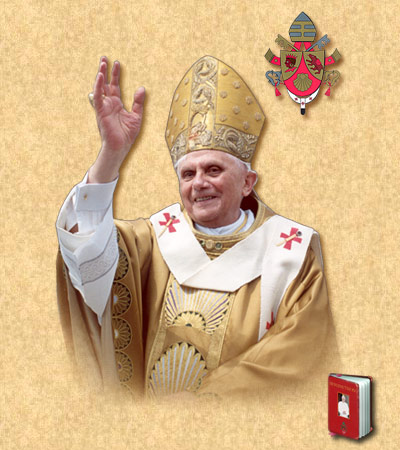
Interim Pope?

Today, as you know, Pope Benedict XVI announced his resignation effective at the end of February. There are many different responses to this act of stepping down, including questions about whether he always intended to be an "Interim Pope."

Source: http://www.vatican.va/holy_father/benedict_xvi/index.htm

For my money, I don't think Pope Benedict XVI saw his calling to that position as an interim one. I ran across this blogpost on Facebook shortly after I heard the news. The post posits that stepping down was the act of a faithful man who recognizes that he can no longer faithfully execute his ministry, and that perhaps we can also be called to step down from what has been a long and fruitful calling as well.

I've been working with St. Andrew's Presbyterian Church since May of 2012, and we've been going through a visioning process the last month or so to figure out where the church should go next. One of the discussions we had was of expanding our ministry with older adults, the saints of the church who have been leaders for decades.

If we move forward with that ministry, I think part of it needs to be teaching the kind of faith exhibited by Pope Benedict XVI in his willingness to step down. Because if we hold on to our past we never give the future an opportunity to develop.

As we move forward, we have to honor the contributions of those who have been active leaders, but we also have to teach those leaders how to pass on the torch so that their organization can continue to grow with each new generation, and not be tied to one group.

It's easy for a young person to say, and maybe I'll feel differently when I'm on the other end of this equation, but at some point the baton has to be passed so that the race may continue. Giving up that control is scary, because sometimes it won't get picked up, and frequently won't get picked up in the same way.

But remember the truth of the resurrection. Death is not something we need to fear, neither is the decline that leads to it. Because that death is not the end of our story. As programs die, new ones spring up to do different work, the needs of the community shift, and to hold on to old solutions when they no longer fit doesn't make sense.

So Pope Benedict XVI, this protestant hopes that your example rings throughout the universal Church, and that we examine if we are called to a specific ministry, or if we are called to step down from our positions and trust God to act through others.

What do y'all think? Is his resignation an act of faith or a cop-out? An example to follow or an illustration of the ailing of the church as an illustration? Let me know in the comments!