My friend Rev. Dan McCurdy, a pastor in Wisconsin, posted this on a Facebook group of which we are both members. I think it's one of the most important things I've seen on the internet. It's reposted here with his permission. Often times, in my experience, clergy and chaplains are looked to for this kind of ministry so that family/friends don't have to. However we often have other responsibilities, one of which is to equip families/friends to deal with these kinds of life changes.
So many people, when confronted with a dying person, avoid them because "they don't know what to say."
This is largely a byproduct of feeling like you need to cheer the other person up, or "make them okay with it." Given how rarely we are OKAY with it (especially if we love the one who is dying) this is a tall order. Luckily, it's not ACTUALLY our job.
So here's how you talk to a dying person.
1. Show up. This is 90% of the battle. So long as you aren't especially, near intentionally horrible, the mere fact that you arrived will make your visit a highlight of their day. The Western fear of death means that many people wind up dying alone, avoided by those who care for them. So show up, and you're off to a good start/
2. Touch them. This goes under the sub-heading of showing up... in the end stages of death, as people become less and less aware of what is happening around them, physical contact makes your presence a little more real. Most of the time, what is killing the person isn't contagious through simple physical contact, so unless there are signs around warning you off, feel free to put a hand on their arm or shoulder. (Washing your hands before you walk into the room, of course.) A lot of dying people go days at a time without being touched in a friendly way. It helps them feel more human in a time where a lot of their humanity is being taken from them.
3. "How is Today?" At least once, by accident, you will give your dying friend or loved one the opportunity for the best joke dying has given them... "How are you?" "I'm dying. You?" After the fun of that, a better greeting is "How is Today?" Terminal diseases have good days and bad days. This is a way to find out how they are feeling on this specific day, and lets you know what is going on.
4. Don't be afraid to talk about yourself. A dying person often feels like the world around them is gone... people around them only talking about the disease, funeral arrangements, travel plans, etc. If they ask you questions about what you are up to, don't feel the need to turn the conversation back around onto them, saying; "Well, that's not important right now..." let them dictate what is important, If that includes asking if you've beaten your high score on Candy Crush Saga yet, answer them.
5. Watch for leading questions. If they ask you a question like; "What do YOU think happens when we die," give your answer with a nutshell, and then ask them what they think. These questions are often looking for an opportunity to explore some murky concepts. Tell the truth, and listen for the truth they tell when you return the question.
6. Let them steer the conversation. If the deep talk gets to deep, they'll yank the wheel and take it somewhere else entirely. Let them. In a world where more and more decisions are being taken from them, allow them to dictate this.
7. Do not compulsively fill every silence. If they go quiet, and you don't have anything to say, don't feel the need to babble for the sake of babbling. Silence can be golden.
8. When the time comes to leave, make definite plans to come back. Whenever possible, pick an exact date and time. "I'll see you around" is too nebulous and opens up a strong possibility of "Is this the last time I'll see you." It can ruin a happy day. So be definite. It doesn't assure anything, but it sure leaves the visit on a strong note.
And finally, remember that no matter how far gone they are, until the very end, unless they were clinically deaf before, assume that they can hear you. Talk TO them when you are in the room, instead of always talking over them. Tell them that you love them, that you'll miss them, anything you need to say.
And when the time comes, say goodbye.
Showing posts with label death. Show all posts
Showing posts with label death. Show all posts
Wednesday, June 11, 2014

Monday, November 11, 2013
Continue
Continue from Joseph Taber on Vimeo.
Haggai 2:1-9
In the second year of King Darius, in the seventh month, on the twenty-first day of the month, the word of the Lord came by the prophet Haggai, saying: 2Speak now to Zerubbabel son of Shealtiel, governor of Judah, and to Joshua son of Jehozadak, the high priest, and to the remnant of the people, and say,
3Who is left among you that saw this house in its former glory?
How does it look to you now? Is it not in your sight as nothing?
4Yet now take courage, O Zerubbabel, says the Lord;
take courage, O Joshua, son of Jehozadak, the high priest;
take courage, all you people of the land, says the Lord;
work, for I am with you, says the Lord of hosts,
5according to the promise that I made you when you came out of Egypt.
My spirit abides among you; do not fear.
6For thus says the Lord of hosts:
Once again, in a little while,
I will shake the heavens and the earth and the sea and the dry land;
7and I will shake all the nations,
so that the treasure of all nations shall come,
and I will fill this house with splendor,
says the Lord of hosts.
8The silver is mine, and the gold is mine, says the Lord of hosts.
9The latter splendor of this house shall be greater than the former,
says the Lord of hosts;
and in this place I will give prosperity,
says the Lord of hosts.
Luke:20:27-38
27Some Sadducees, those who say there is no resurrection, came to him 28and asked him a question, “Teacher, Moses wrote for us that if a man’s brother dies, leaving a wife but no children, the man shall marry the widow and raise up children for his brother. 29Now there were seven brothers; the first married, and died childless; 30then the second 31and the third married her, and so in the same way all seven died childless. 32Finally the woman also died. 33In the resurrection, therefore, whose wife will the woman be? For the seven had married her.” 34Jesus said to them, “Those who belong to this age marry and are given in marriage; 35but those who are considered worthy of a place in that age and in the resurrection from the dead neither marry nor are given in marriage. 36Indeed they cannot die anymore, because they are like angels and are children of God, being children of the resurrection. 37And the fact that the dead are raised Moses himself showed, in the story about the bush, where he speaks of the Lord as the God of Abraham, the God of Isaac, and the God of Jacob. 38Now he is God not of the dead, but of the living; for to him all of them are alive.”
This is the Word of the Lord
Thanks be to God
Over the last several years, I've noticed something peculiar about American culture. We are totally youth obsessed. We spend untold amounts of time and money to avoid the reality of our own aging. Maybe it’s because we remember the past more fondly than we read the present. Maybe we look towards the former glory of our houses because we have become discouraged with the work required to maintain them, to rebuild time after time.
I think that's because, at some level, we know that we have a shelf life. We are limited both in our ability and in our time. Our limits terrify us, the death and loss we experience during our lives are so far beyond even the illusion of our control that we reach into the illusion of eternal youth to avoid dealing with the most terrifying events in our lives. We are consistently taught, as American Christians, that grief and fear are “bad” emotions, and should be treated as though something is broken in our minds.
But the human condition is a frightening one, throughout our lives, we have to deal with loss, with grief, with pain, much of the time through no fault of our own. In my work at the hospital, even the most gifted doctors much eventually face that everything they do is just a stall tactic. Avoidance of these frightening realities may be easier than dealing with them, but pretending they don’t exist doesn’t solve them, and I’m not convinced it actually makes it more bearable.
I think that when we run as hard as we do from the things that frighten us, it makes us think that we have to bear them alone when they do finally catch up to us. When we can no longer avoid the grief over the loss of a dear friend or relative, we feel like we cannot reach out to anyone else because no one else is grieving in the ways we are. By avoiding them, we are allowing them to fester, merely so that we can keep up the cultural illusion that we are not susceptible to those dark emotions.
Death is a reality, and an eventuality, for us all. And that is a terrifying prospect, so much so that we go to great lengths to avoid even the appearance of approaching that end. Searching for a way to increase our reach into the future, straining for something beyond the scope of our life on this planet. We search for eternal youth, for a measure of immortality, the idea that our deaths are only in part.
The Christian claim is not one of immortality, it is of resurrection. Because we will all face the trauma of loss and death. If we trust a continuity based on our own abilities, we will find ourselves paralyzed in the face of the limits of our imagination.
The prophet Haggai finds himself in that position. He is among the Jews who return to the promised land after what's called the Babylonian captivity. It's one of the pivotal moments in scripture, for before this time the understanding of God centered around the protection of the law, the covenant, and above all the holy city of Jerusalem which housed the temple. God was one who preserved the life of his people.
But the temple has been destroyed, the people of the land have been carried off to a foreign country, away from their ancestral inheritance. Though some of the people have survived, and have been allowed to return home, they have lived through a trauma so severe that American culture has no common frame of reference. Everything they understood about reality, about their identity, about their God, is dead.
But the covenant is not one of immortality, but of resurrection. God speaks to their spiritual death:
"Who is left among you that saw this house in its former glory?
How does it look to you now? Is it not in your sight as nothing?"
The temple-centered religious practices are dead. But God is not. Though lives have been lost, though faith has been lost, the God of their covenant is working on their resurrection, and encourages them to rebuild, not because they are invulnerable to another conquest, but because not even death can separate us from the love of God. It is not the glory of the temple that matters, it is the glory of God. Though the temple may be lost, the presence of the LORD is still among us. So God tells us to not be paralyzed by our fear that even the greatest of our works will fade in time.
"Take courage, all you people of the land, says the Lord;
Work, for I am with you, says the Lord of hosts."
It is easy to become discouraged when they look around and see the limitation of their humanity, and the fruits it has borne for them. There is much to fear, Haggai's congregation do not have a King of the line of David on the throne, they have a governor appointed by their captors. They have a high priest, but no place for him to carry out his duties. The work of their hands has been laid waste with fire and sword at the hands of the Babylonian army. Their exile has been real, so have the deaths that they have witnessed on their journey.
Just so our own journeys take to places we would not choose to go. Sometimes they take us to a sports field, where we begin to realize that our bodies can no longer do what we ask of them. Sometimes they take us to a rite of passage and we are confronted with the vision that the one who we are so accustomed to seeing as a child has become an adult, and our relationship has irrevocably changed. Sometimes they take us to the edge of a hospital bed, where we hear the doctor say words that we cannot accept, news of finality, of saying goodbye instead of new greetings.
The theoretical Widow in our gospel passage has found that grief time and time again, having buried seven husbands. But it’s not her grief that concerns the Sadducees in our gospel passage this morning. These learned men, wealthy and powerful, pose the question as a trap, to get Jesus to admit that the resurrection isn’t logical.
Well they’re right, it’s not.
Where’s the logic in the grief of a seven-fold widow being transformed to songs of praise? Where’s the logic in a barren mother being called a child of the resurrection? Where’s the logic in a conquered people reinvesting in a temple to a God who hadn’t prevented disaster?
Where’s the logic in a God who refuses to give up on us when we so consistently abandon God? Where’s the logic in an all-powerful God who goes to death, even death on a cross?
The resurrection is not about logic, it’s about the greatness of God, who can triumph even over the fact of death.
God’s covenant is not one of immortality, it’s one of resurrection. Where there once was only death, now there is life, and life abundant. For God is not of the dead, but of the living. John Donne wrote that “All [humanity] is of one author and one volume, and when one [person] dies, a chapter is not torn out of the book, but translated into a better language; and every chapter must be so translated.” And as we wait for our own translation, we will lose access to friends and family who are taken by death before us. That loss is real, and deserves to be mourned.
We confess that Christ was crucified, died, and was buried. But through the loving power of our God, death was not the end of his story, and it’s not the end of ours. Because we are witnesses to resurrection: the creation of life where there was only death. That resurrected life will be one of greater glory than we can now imagine.
The Sadducees assumed that in the resurrection, everything would be back to the life they understood, the life that had enriched them, that they understood and could work within, only with everybody alive again.
But the God who writes and rewrites the laws of nature does not just raised us from the dead, we are reformed in this resurrection. Not just humanity either, all of creation is redeemed through the death and resurrection of Christ, that is the new form of humanity. “For thus says the Lord of hosts: Once again, in a little while, I will shake the heavens and the earth and the sea and the dry land; ...The latter splendor of this house shall be greater than the former, says the Lord of hosts.”
The resurrected life is one where we dine with our Lord, no longer held back by our fears and grief, but loved through them. Our fears are redeemed to joy, our grief to gratitude, our despair to faith. Because the power of the God of resurrection makes it so.
Because the God who loves us enough to become a human, with all of our limits, like us in every respect except sin, will let neither sin nor death separate us from God. The God whose sovereignty speaks into being things which do not exist declares us to be children of the resurrection.
So the widow no longer needs to be defined by her ability to bear children and continue the family line. The sinner no longer needs to be cast out for his uncleanness. The wealthy businessman no longer needs to focus on acquiring enough stuff to pass on his legacy. The temple no longer needs to compare itself to a faded memory of its own glory. The church elder no longer needs to hold up the church on his own, fearing that if he steps away that no one will fill the void.
Now they are all called children of the resurrection, worshipping God in spirit and in truth, not in a temple or church.
“So then, brothers and sisters, stand firm and hold fast to the traditions that you were taught by us, either by word of mouth or by our letter.” Because ours is a tradition not of immortality, but of resurrection. Our tradition says that death may be more powerful than we are, but our God is more powerful than death by far. We will grieve those we have lost, and we will grieve for ourselves when we lose parts of ourselves. When our time comes, others will grieve for us as well.
But that grief is not the end of our story, because God’s story continues forever, and God’s love for us is such that he wants us to be a continual part of that story. A story of creation, resurrection, and everlasting praise.
Tuesday, May 28, 2013
Crowd-Sourced Exegesis: Luke 7:11-17
Proper 5C/Ordinary Time 10C/Pentecost +3C
11A little later Jesus went to a city called Nain. His disciples and a great crowd traveled with him. 12As he approached the city gate, a dead man was being carried out. He was his mother's only son, and she was a widow. A large crowd from the city was with her. 13When he saw her, the Lord had compassion for her and said, "Don't cry." 14He stepped forward and touched the stretcher on which the dead man was being carried. Those carrying him stood still. Jesus said, "Young man, I say to you, get up." 15The dead man sat up and began to speak, and Jesus gave him to his mother.
16Awestruck, everyone praised God. "A great prophet has appeared among us," they said. "God has come to help his people."17This news about Jesus spread throughout Judea and the surrounding region.
To leave a comment, type your response in the box below. Choose a way to identify yourself using the drop-down menu, Then click "Publish."
Monday, February 11, 2013
Interim Pope?
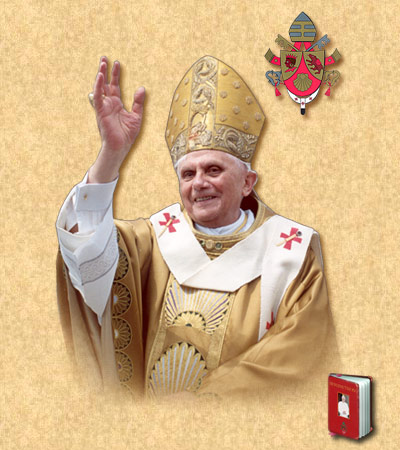
Today, as you know, Pope Benedict XVI announced his resignation effective at the end of February. There are many different responses to this act of stepping down, including questions about whether he always intended to be an "Interim Pope."
For my money, I don't think Pope Benedict XVI saw his calling to that position as an interim one. I ran across this blogpost on Facebook shortly after I heard the news. The post posits that stepping down was the act of a faithful man who recognizes that he can no longer faithfully execute his ministry, and that perhaps we can also be called to step down from what has been a long and fruitful calling as well.
I've been working with St. Andrew's Presbyterian Church since May of 2012, and we've been going through a visioning process the last month or so to figure out where the church should go next. One of the discussions we had was of expanding our ministry with older adults, the saints of the church who have been leaders for decades.
If we move forward with that ministry, I think part of it needs to be teaching the kind of faith exhibited by Pope Benedict XVI in his willingness to step down. Because if we hold on to our past we never give the future an opportunity to develop.
As we move forward, we have to honor the contributions of those who have been active leaders, but we also have to teach those leaders how to pass on the torch so that their organization can continue to grow with each new generation, and not be tied to one group.
It's easy for a young person to say, and maybe I'll feel differently when I'm on the other end of this equation, but at some point the baton has to be passed so that the race may continue. Giving up that control is scary, because sometimes it won't get picked up, and frequently won't get picked up in the same way.
But remember the truth of the resurrection. Death is not something we need to fear, neither is the decline that leads to it. Because that death is not the end of our story. As programs die, new ones spring up to do different work, the needs of the community shift, and to hold on to old solutions when they no longer fit doesn't make sense.
So Pope Benedict XVI, this protestant hopes that your example rings throughout the universal Church, and that we examine if we are called to a specific ministry, or if we are called to step down from our positions and trust God to act through others.
What do y'all think? Is his resignation an act of faith or a cop-out? An example to follow or an illustration of the ailing of the church as an illustration? Let me know in the comments!
 |
| Source: http://www.vatican.va/holy_father/benedict_xvi/index.htm |
For my money, I don't think Pope Benedict XVI saw his calling to that position as an interim one. I ran across this blogpost on Facebook shortly after I heard the news. The post posits that stepping down was the act of a faithful man who recognizes that he can no longer faithfully execute his ministry, and that perhaps we can also be called to step down from what has been a long and fruitful calling as well.
I've been working with St. Andrew's Presbyterian Church since May of 2012, and we've been going through a visioning process the last month or so to figure out where the church should go next. One of the discussions we had was of expanding our ministry with older adults, the saints of the church who have been leaders for decades.
If we move forward with that ministry, I think part of it needs to be teaching the kind of faith exhibited by Pope Benedict XVI in his willingness to step down. Because if we hold on to our past we never give the future an opportunity to develop.
As we move forward, we have to honor the contributions of those who have been active leaders, but we also have to teach those leaders how to pass on the torch so that their organization can continue to grow with each new generation, and not be tied to one group.
It's easy for a young person to say, and maybe I'll feel differently when I'm on the other end of this equation, but at some point the baton has to be passed so that the race may continue. Giving up that control is scary, because sometimes it won't get picked up, and frequently won't get picked up in the same way.
But remember the truth of the resurrection. Death is not something we need to fear, neither is the decline that leads to it. Because that death is not the end of our story. As programs die, new ones spring up to do different work, the needs of the community shift, and to hold on to old solutions when they no longer fit doesn't make sense.
So Pope Benedict XVI, this protestant hopes that your example rings throughout the universal Church, and that we examine if we are called to a specific ministry, or if we are called to step down from our positions and trust God to act through others.
What do y'all think? Is his resignation an act of faith or a cop-out? An example to follow or an illustration of the ailing of the church as an illustration? Let me know in the comments!
Monday, October 15, 2012
Choosing to die?
Listen up churches,
You have the option, and it's not one I'm going to choose on your behalf. You may choose to die. But if that is the option you have chosen, don't pretend, be honest about it. There's no shame in answering the call to death so that new life may spring up.
But don't pretend that you're interested in growth if you're not willing to change.
Growth is a kind of change.
When churches change, one of the complaints that ministers often here is that "This doesn't feel like my church anymore." Here's my response:
Was it ever yours to begin with? Or is does the church belong to Jesus Christ?
A church with whom I used to be associated has recently realized that their old members keep getting older, and new members are not replacing them. The result has been that they are trying to grow those young families, they say they want them, and are implementing programs to gather them in.
But they're not willing to actually change anything. It's like they're looking for young families who are already the same as they already are.
Well if you're not attracting new members, perhaps that oppressive sameness is the reason? Each generation has its own needs, its own issues, and for a church to fail to deal with them ignores their existence and doesn't feed the hunger that each group has. You may as well have worship in a different language!
If you are choosing not to change how you do things, you are choosing to die as an institution. Which is absolutely ok. If God is calling you as a church to minister to congregation as it declines and dies, we believe in the resurrection, and if God so wills it, a new church will rise up.
But don't pretend you want new people if you're not willing to change to accommodate them. The holy spirit is active in every time and place, and "that's the way we've always done it" is not a good enough reason.
You have the option, and it's not one I'm going to choose on your behalf. You may choose to die. But if that is the option you have chosen, don't pretend, be honest about it. There's no shame in answering the call to death so that new life may spring up.
But don't pretend that you're interested in growth if you're not willing to change.
Growth is a kind of change.
When churches change, one of the complaints that ministers often here is that "This doesn't feel like my church anymore." Here's my response:
Was it ever yours to begin with? Or is does the church belong to Jesus Christ?
A church with whom I used to be associated has recently realized that their old members keep getting older, and new members are not replacing them. The result has been that they are trying to grow those young families, they say they want them, and are implementing programs to gather them in.
But they're not willing to actually change anything. It's like they're looking for young families who are already the same as they already are.
Well if you're not attracting new members, perhaps that oppressive sameness is the reason? Each generation has its own needs, its own issues, and for a church to fail to deal with them ignores their existence and doesn't feed the hunger that each group has. You may as well have worship in a different language!
If you are choosing not to change how you do things, you are choosing to die as an institution. Which is absolutely ok. If God is calling you as a church to minister to congregation as it declines and dies, we believe in the resurrection, and if God so wills it, a new church will rise up.
But don't pretend you want new people if you're not willing to change to accommodate them. The holy spirit is active in every time and place, and "that's the way we've always done it" is not a good enough reason.
Subscribe to:
Posts (Atom)